


By Dr. Rod Berger
On Thursday, November 12, Representative Chip Roy of Texas walked to the lectern on the House floor and spent close to half an hour taking his own party apart.
“Somebody tell me why Republicans lost last Tuesday?” he asked. “I’ll say it’s because they were focused on themselves and the ruling class and not the people.”
He said Republicans passed what he called a great bill and then never campaigned on it. He went after the redistricting push. He went after the choice to put Ken Paxton, whom the Republican Texas House had impeached, at the top of the Texas ticket. He faulted the president for taking the country into Iran without asking Congress: “You can’t decide it by edict from the other end of Pennsylvania Avenue.” Then: “The arrogance! The arrogance of the powers that be, the masters of the universe, who tell you that that’s what you have to do.”
He even reached for this week’s other story. “You watch Nvidia’s CEO embroiled in scandal,” he said, “and you see how everybody’s patting each other on the back, helping each other in the billionaire class and the ruling class.”
“When you pursue political power over the people, you lose.”
Roy leaves Congress on January 3. He lost the Republican runoff for Texas attorney general, and The Hill noted the speech could be his last from that floor. He had raised some of this before the votes came in; six days before the election, he went on CNN and urged the president to talk about gas, diesel, home and food prices. A year earlier, though, his warning pointed the other way. Republicans would face “a bloodbath,” he said, if they sat back and undermined President Trump.
I don’t hold that against him. People revise their reading of a situation. That is the whole point of reading it.
Look at the calendar, though, and not only his. In the ten days since the election, you have probably heard some version of Roy’s speech from people who said very little of it a year ago, when saying it carried a price. The analysis sounds sharp now. It also costs nothing.
Why do we find our voice once the outcome is settled? And what does that habit cost us when the next big question has no party attached to it?
Americans have run this experiment before.
Snow White and the Six Dwarfs
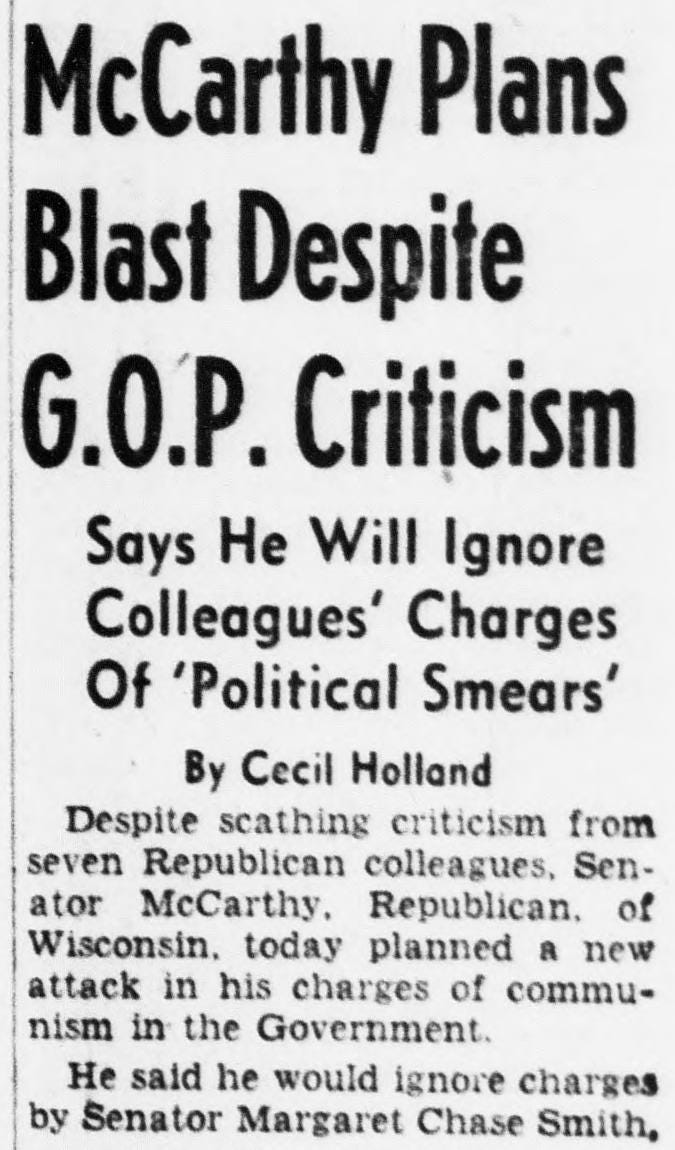
In February 1950, in Wheeling, West Virginia, Senator Joseph McCarthy claimed he held the names of 205 card-carrying communists working in the State Department. Four months later, on June 1, Senator Margaret Chase Smith of Maine, the only woman in the Senate, stood up and delivered what she called a Declaration of Conscience. Six fellow Republicans signed it with her.
McCarthy dismissed them as “Snow White and the Six Dwarfs.”
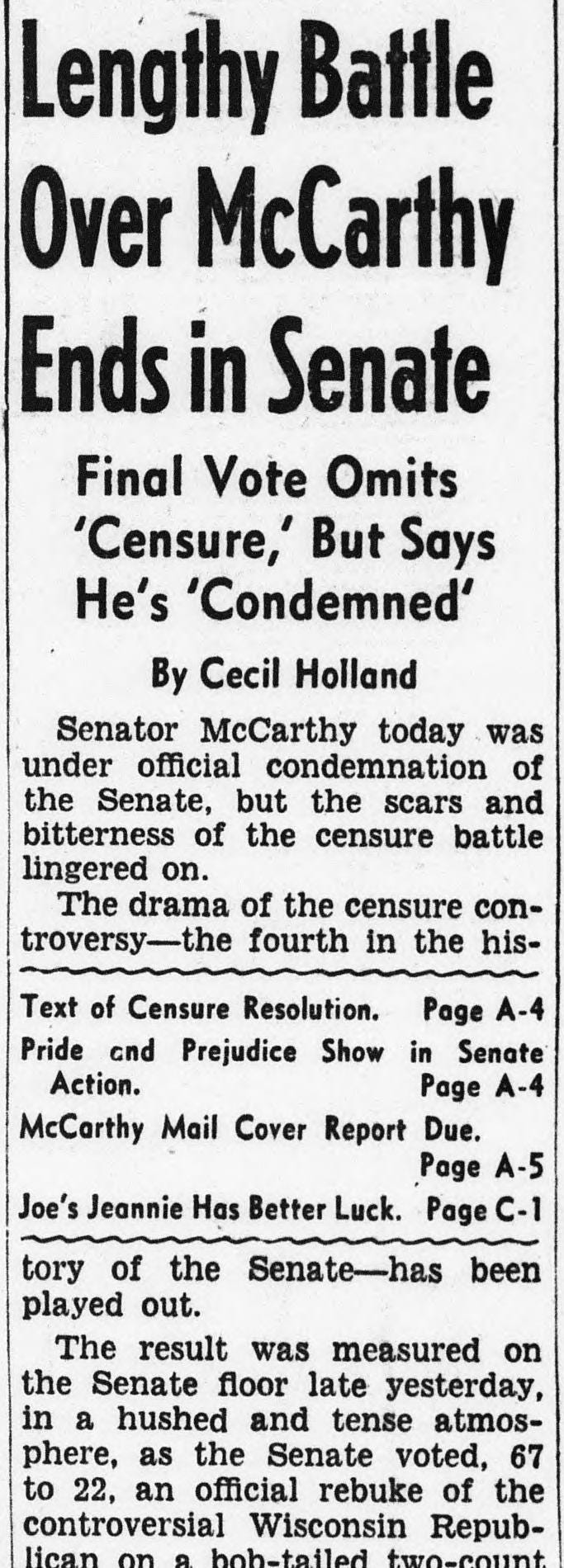
Then came the long quiet. For four more years, most of Washington kept its head down. The courage returned in April 1954, when the Army-McCarthy hearings put him on television day after day and the country watched the man for itself. On December 2, 1954, the Senate voted 67 to 22 to censure him. A Republican, Ralph Flanders of Vermont, had introduced the motion.
McCarthy’s conduct barely changed between 1950 and 1954. The cost of naming it did.
With a Heavy Heart
Watergate began as a story most Americans skimmed. On June 17, 1972, police arrested five men inside the Democratic National Committee offices, and the White House press secretary waved it off as a third-rate burglary. Six days later, on Friday, June 23, President Nixon sat with his chief of staff, H.R. Haldeman, and talked through using the CIA to slow the FBI’s investigation. A tape recorder in the room caught every word.
The country heard that tape twenty-five months later.
By late July 1974, the House Judiciary Committee was voting on articles of impeachment. On July 27, six of its seventeen Republicans voted for the first article. The other eleven voted no. On August 5, the White House released the June 23 transcript, and within days the committee Republicans who had voted against every article, Nixon’s firmest defenders, announced that they would now vote to impeach. The ranking Republican, Edward Hutchinson of Michigan, said he would do it “with a heavy heart.”
On August 7, Senator Barry Goldwater, Senate Minority Leader Hugh Scott and House Minority Leader John Rhodes went to the White House. They told the president that no more than fifteen or so senators would vote to acquit him. He needed thirty-four. The next evening he announced his resignation, and at noon on August 9 he left office.
The tape didn’t reveal a new Richard Nixon. It removed the last place his defenders could stand.
A Good Idea, Badly Carried Out
The pattern travels.
In occupied Germany after 1945, denazification ran on paperwork, and Germans swapped sworn character references so freely that people nicknamed the documents Persilscheine, after the laundry detergent. A certificate that washed you clean.
The American occupation government also asked Germans directly what they thought. In November 1945, 53 percent of respondents in the American zone and the American and British sectors of Berlin told surveyors that National Socialism was “a good idea badly carried out.” In August 1947, more than two years after the world saw the camps, the figure stood at 55 percent. Among Germans under thirty, it reached 68 percent (OMGUS surveys, 1945 to 1947).
Defeat changed what people said in public. It changed far less of what they believed.
Milton Mayer, an American journalist, spent time in postwar Germany getting to know ten ordinary German men in a town he called Kronenberg. He published what he learned in 1955 under a title that still stings: They Thought They Were Free.
A speech after the loss can be a change of conviction. It can also be a change of costume.
The Free Question
When you are winning, a hard question carries a price: your seat, your donors, your friends at dinner, your sense of who you are. When you lose, the price drops to zero, and suddenly everyone can afford to ask.
The information usually sits in plain view. What runs short is the willingness to ask a question when we suspect the answer will cost us the story we tell about ourselves.
I call the skill we are missing Narrative Discernment: the ability to see how a story is built, whose interests it serves and what it asks you to do. It comes easily when the story belongs to someone you oppose. It comes hardest when the story flatters you, pays you or keeps you in the room.
You have seen the same thing far from Washington. You have watched a company discover its culture problem on the morning of the layoffs. You have watched a family name the drinking at the funeral. The facts sat there for years. The permission to say them arrived with the loss.
The Story We May Be Standing Inside
Which brings me back to the story Roy named from the lectern, the one that belongs to no party.
On November 8, Nvidia chief executive Jensen Huang told employees he had had an extramarital affair. The New York Times reported that U.S. surveillance suggested the woman, Alice Huang, no relation, was passing information to Beijing. On November 9, Nvidia shed about $192 billion in market value in a single session. On November 12, the company’s board announced that Huang had resigned, effective immediately. Congress now wants him to testify.
The Times also reported that U.S. intelligence briefed President Trump about the relationship twice, the second time when Secretary of State Marco Rubio raised the counterintelligence risk around the president’s May trip to Beijing, a trip Huang joined (CBS News timeline). Asked on November 9 when he first learned of the allegations, the president said “not too long ago” and that “it didn’t make much of an impact on me.” He called Huang an honorable man. CNN, citing a source, reported that he had encouraged Huang to fight the calls to step down.
We don’t know what those briefings said or how firm the intelligence was. We don’t know what anyone did after hearing it. The president says Huang told him he had no idea about the woman’s ties. Much of the reporting rests on unnamed sources.
Nvidia builds the chips the AI race runs on, and in July 2025 the company said it had the administration’s approval to sell its H20 chips to China. If a foreign intelligence service had a window into the company at the center of that race, the damage will not check anyone’s voter registration. We all lose that one.
In June 1972, the most consequential conversation of the Nixon presidency took a few minutes on an ordinary Friday, and almost no one outside the room knew it mattered. Watergate didn’t feel like Watergate while it was happening. For most of the country, it felt like a burglary item on an inside page.
Watergate didn’t feel like Watergate while it was happening.
Is this our June 1972? I don’t know. Neither do you. That is exactly why the questions belong to this week, while asking them still costs something. Who was told? What did they do with it? And who is willing to ask before the outcome settles the matter for them?
Late Is Not Never
I’m writing this from the cheap seats. Questioning a party that just lost an election costs me nothing, which is the very move I have spent this piece examining. If you read it and thought only about the other side, you made the same move.
Roy said something else on Thursday that deserves a second hearing: “The people right now are not in love with either party.” The side celebrating this month carries its own list of questions it has not asked, and winning raises the price of every one of them.
And late courage still counted. Flanders’s motion ended McCarthy’s run. Nixon’s last defenders ended his presidency. So don’t sneer at the people who arrive late. Ask what made them late, and what would have made them early, because the answer to that one describes you, too.
Sit with these:
When did you last change your mind about someone on your own side, and what made it finally safe to say so?
What question have you been holding until there is more evidence, and how much evidence would actually be enough?
Who in your life pays a price for saying the hard thing early, and do you stand next to them while it still costs something?
If this turns out to be the Watergate of your lifetime, what will you want to have said this week?
What do you already suspect about your own side that you are waiting to lose before you say out loud?
Tell me your answer to that last one in the comments. You don’t have to sign it with more than a first name.
A note on limits: The Huang story is days old, and much of it rests on unnamed sources; neither the content of the briefings nor anyone’s response to them is public. The 1945 to 1947 German figures come from American military government surveys of the U.S. zone and Berlin, not the whole country. Nothing here establishes that anyone in this week’s story broke a law.
Meet your host
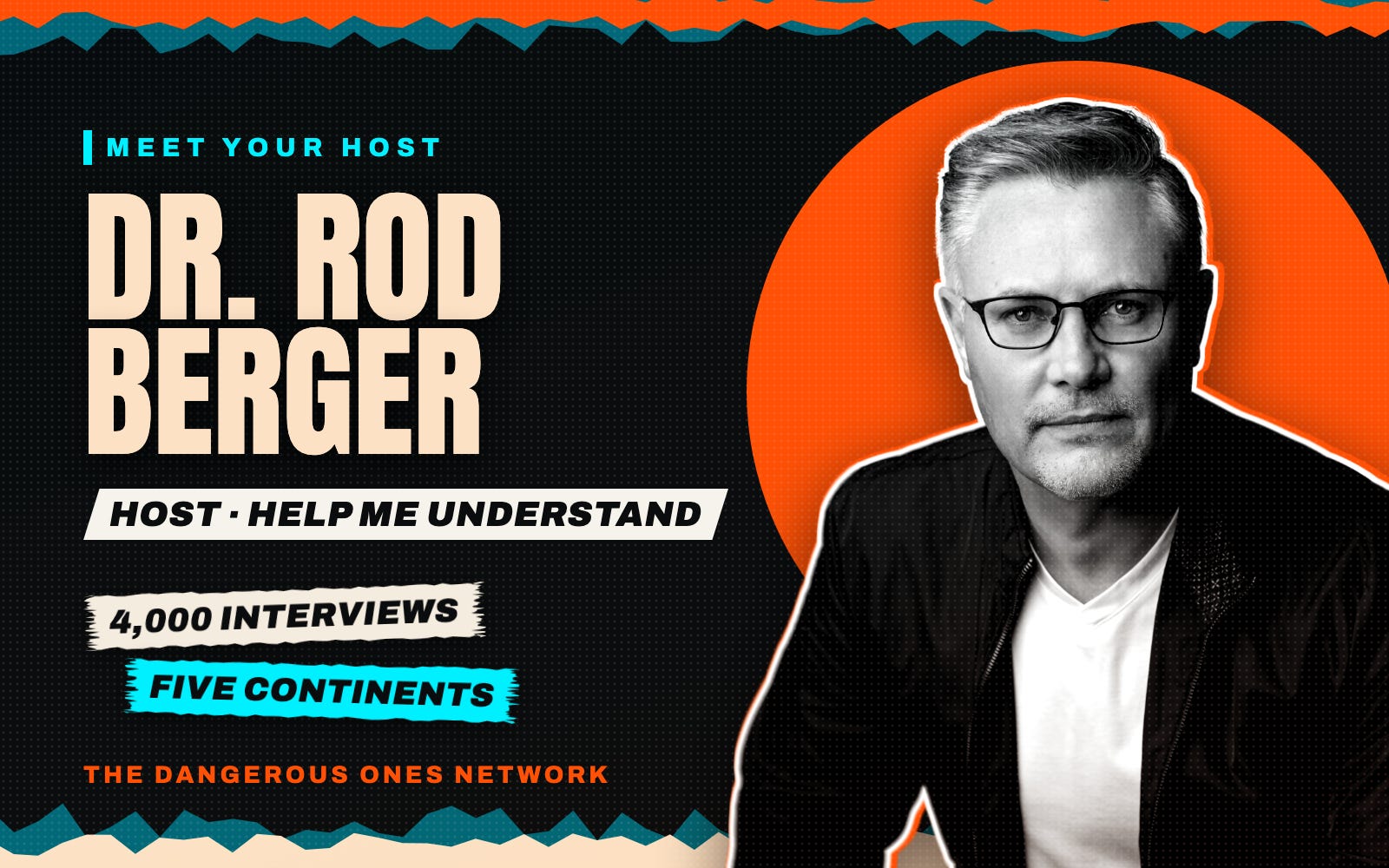
I’ve written for Forbes and Entrepreneur, and I serve as Editor-at-Large at Fair Observer. For nearly two decades, I was a guest lecturer on Storytelling in Business at Vanderbilt’s Owen Graduate School of Management. You’ll find more of my work at drrodberger.com.
Here, my job is narrower. The callers can take a side. I don't. I go looking for where we've seen this before, and I bring back the strongest case each side can make.
Help Me Understand, the podcast
Help Me Understand is my podcast on The Dangerous Ones Network. Each episode takes the stories from the news that make no sense to an ordinary person and asks the question we should be asking and aren't.
Latest episode: Who Plays by the Rules Now. The new majority's first week: a lawyer-up post, an impeachment vote and a promise on stock trading you can check.
Recent episodes: The Standard at Home, Not Their Money, Their Power with Marshall Herskovitz, Who Stayed Home, The Weeks In Between, and The Three-Point Plan with Marshall Herskovitz.
The book
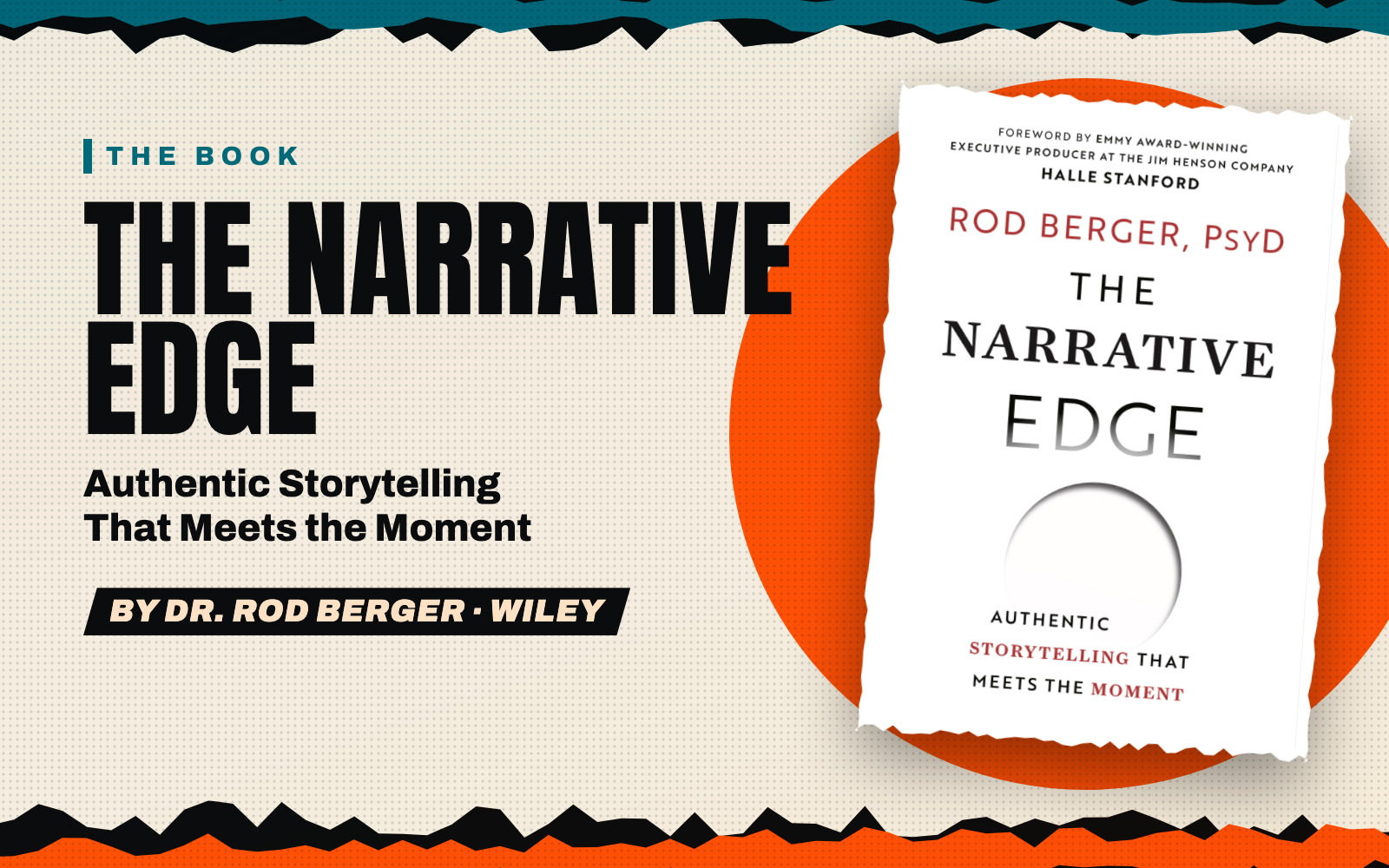
Most of us live inside stories we never chose. Someone handed them to us, and we kept telling them.
The Narrative Edge: Authentic Storytelling That Meets the Moment (Wiley) is my book about learning to see those stories: how a story gets built, whose interests it serves, and what it asks you to do. Help Me Understand brings the same habit to the news.
Watch or listen: Who Plays by the Rules Now
Help Me Understand with Dr. Rod Berger, on The Dangerous Ones Network. Have something you're trying to understand? Call The People's Hotline and leave a message: 503-212-4600.